WebRTC Digest – Week of 5/27 – Flow Charts, FUD, and T-Shirts
Good in-depth explanations of WebRTC are still few and far between. Fortunately, Anant Narayanan of Firebase (and previously the WebRTC team at Mozilla) made a big contribution to the presentation-pool last week with his talk A Practical Introduction to WebRTC at Fluent Conference.
Be sure to check out the slides for the most complete set of WebRTC signaling flowcharts on the web (use the down arrow on slide 7). Seriously. if you want to understand what’s going on under the hood when you click “Start Call” in a WebRTC app, you need to read the flowcharts. We’ll wait.
FUDdy-duddy
WebRTC was top of mind over at No Jitter last week, with no fewer than three posts on the topic. Irwin Lazar of Nemertes Research led off with a positive piece titled WebRTC: Why Should Enterprises care?
Perhaps more exciting is the opportunity to give CRM or ERP applications their own voice/video applications directly embedded into their web interfaces […] Think about a team of people who live in a business process application all day who can chat, talk, or video chat with each other […] Again, here the opportunities are endless for application developers to extend rich communications and collaboration anywhere.
Then Laurent Philonenko, VP/GM of Cisco’s Clients and Mobility Business Unit rained on the WebRTC parade with The Reality of WebRTC…All Hype?
[…] WebRTC is not quite ready for prime time. Simply put, the standards are not done. Assume the WebRTC standards completion is still one year out, and that it takes six months for Chrome and Firefox to ship a browser with the final standards; plus add the time for people to upgrade their browsers. We’ll see early implementations before, but I’d say it’s two-plus years before this technology is widely deployed in the market.
Dave Michels closed out with WebRTC Hype Check, kindly explaining that there’s nothing to see here, and you folks should really just move along.
WebRTC is not disruptive. […] WebRTC does not offer new capabilities, nor significant cost savings over other peer-to-peer technologies. WebRTC could be more accurately described as an evolutionary technology–effectively bringing real-time capabilities to the browser instead of reliance on ad-hoc plugins and downloads.
We’re biting our tongues for now, but you can expect to hear more on this subject here on the vLine Blog. In the meantime, we’ll be polishing up the design on our new line of “WebRTC Is Ready” T-Shirts.
Seriously. Drop us a line if you’d like one.
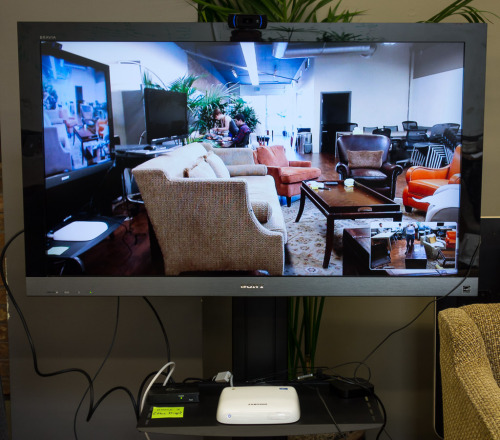
GitTogether: Video Chat for GitHub (powered by WebRTC)
tl;dr
- Go to gittogether and login with GitHub.
- See people you follow on GitHub plus members of your teams and organizations as contacts.
- If the people you want to talk to aren’t online or aren’t in your contact list, send them your GitTogether url (gittogether GitHub).
- Chat away!
Background
It’s hard to know if your platform is any good until you’ve used it to build a real app, preferably one that you use yourself on a daily basis. So, when we first started developing the vLine platform and API two years ago, we also started building an app on top of it.
Since our lives basically revolve around GitHub, we decided to build a communications tool that does, too. We named it GitTogether, gave it a GitHub login, and populated the contacts list from the people you follow or work with on GitHub.
Fast-forward to today, and we have a robust app that we’ve been using internally as our primary communications tool for over a year. Since our main goal was to learn from the experience of building and using it, we never shared it very widely, but enough people have discovered it and found it useful that we figured we should finally spend some more time talking about it.
Over the next few weeks, we’re going to do a series of blog posts on how it works under the hood, what we learned from the process of building it, and how you can build apps that share the same capabilities. But in the meantime, enjoy!
WebRTC Digest – Week of 5/20 – Chrome 27, Temporal Scalability & Hardware Acceleration
Chrome 27
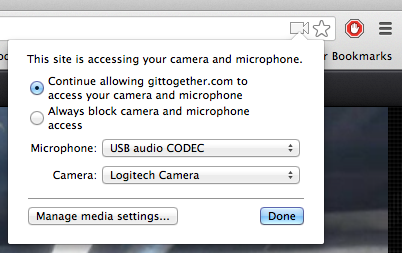
Chrome 27 was officially released. A list of WebRTC-related changes is available on the discuss-webrtc mailing list. One of the most visible changes as an end-user is the ability to select the camera and microphone from the “Omnibox” rather than digging through the Chrome settings.
Temporal Scalability
There was an interesting discussion on the mailing list about temporal scalability and whether controls for it could be exposed in WebRTC through SDP, especially for use with conferencing/mixing. Temporal scalability is a method of encoding a video stream in a format that lets you decode it at multiple frame rates (e.g., 30 FPS or 15 FPS) at the cost of increased encoding overhead. The LifeSize blog provides a nice description in the context of the H264 codec, and the WebM mailing list has a more detailed technical description of how it works in VP8.
Hardware Acceleration
VP8 hardware acceleration continues to be supported by more platforms as nVidia shows with this Tegra 4 demo of 1080p videoconferencing at 30 FPS. The Tegra 4 will have built-in hardware support for both VP8 encoding and decoding, with a stated goal of
Delivering the best WebRTC experience on Android, Chrome OS, and Google TV.
WebRTC Digest – Week of 5/13 – BB10, Firefox 22 & Google IO
WebRTC on Blackberry 10
Our friends at Hookflash kicked off the week by announcing support for WebRTC on Blackberry 10. Erik Lagerway followed up on webrtc-discuss:
Just thought I would let everyone know that we have finished porting Google’s WebRTC media stack in entirety to QNX / Blackberry 10. Currently in our Open Peer github repo, we plan on getting this back upstream, if Google will have it.
WebRTC Tech Lead Justin Uberti, welcomed the news and laid down the ground rules for contributed ports:
Erik, thanks for letting us know. Always good to see someone expanding the WebRTC ecosystem!
Assuming the porting adheres to our style guidelines and our practices for platform-specific code, we can help land this. The only caveat is that we will not be able to fully support it through our trybots and tests. When the build breaks, you will need to fix.
Firefox 22 Hits Beta
On Tuesday, Firefox 21 was released, which leaves only one more version before WebRTC is enabled by default. Firefox 22 is currently scheduled for release on June 24. If you’re impatient, you can get a preview in Firefox Beta, Aurora, or if you’re really brave, Nightly.
Jon Fingas, writing for Engadget, has more on Firefox 22:
Though Mozilla has long been a proponent of WebRTC for plugin-free video and voice chat, it hasn’t been ready to enable the full protocol in Firefox as a matter of course. It’s more confident as of this week…
Google IO
Justin Uberti and Sam Dutton wrapped up the week with a presentation on WebRTC at Google IO. Both the slides and the video are now available for your viewing pleasure.
Janko Roetgers covered the session highlights for GigaOm:
WebRTC, the new technology that enables plugin-free voice and video chat within the browser, should be available on more than one billion unique endpoints (think: desktop browsers and mobile devices) “within a week,” according to Google’s WebRTC engineering lead Justin Uberti.
Endpoints++
Last but not least, Tsahi Levent-Levi has a few suggestions for UC vendors and customers in our favorite post of the week:
All of the room systems and endpoints you are installing? Make them pure WebRTC capable – have them run an HTML5 browser and let Java Script do the rest. Have your own solution use that type of a deployment. All of your legacy products? Have a gateway for them to access the system.
+1 to that.