Skip to content

vLine Welcomes Engineering Gurus

We recently added a couple of powerhouse developers to our team. With their help, we’re excited to be able to turn out functionality you’ve been requesting a little faster.

Jesse Rabek has jumped in to drive our iOS development. His past has taken him through a wide range of projects, including embedded and mobile as well as web development and gaming. Jesse cofounded a startup in Venezuela and managed the driver team at (the late) Palm, Inc.

When he’s not mastering IOS for vLine and WebRTC, he’s probably off gaming, drumming, dancing, or hiking.  @JesseRabek

Jim Wong is currently focused on developing our multi-party conferencing capabilities. He’s steeped in startup experience, most notably on flexible and scalable client-server applications. Before joining us, Jim was an architect and director of engineering at SugarSync. He ran SugarSync’s team that was responsible for core sync features and building the infrastructure to support tens of millions of users and billions of user files. Bytemobile, an industry –leading optimization solution for wireless operators and Vosaic, a pioneering video streaming company in the late 1990’s are other notable startups in Jim’s past.

When not at vLine, Jim enjoys spending time with his wife and kids, playing basketball, and doing the bare minimum maintenance required to prevent his house from falling down. @james_d_wong


Join us! Upcoming SFHTML5 event: All About WebRTC

On Wednesday, October 9 the SFHTML5 group is hosting an event focused exclusively on WebRTC. vLine’s CEO, Ben Strong, will be in the speaker lineup along with fellow WebRTC experts Chris Wilson and Dan Ristic.

The trio will provide an overview, show you how to use WebRTC in your web apps, and give you an opportunity to ask your questions. A follow-up hands-on weekend workshop is also planned. Refer to the Meetup page for more details and registration information. 

Chris, an Open Web Platform Developer Advocate working on Chrome, will kick off the evening with an Introduction to WebRTC.

Ben will talk about “A Practical Guide to Building WebRTC Apps.” He’ll dig into the details of what’s required to transform the promise of WebRTC into a solution that works for you.

Dan, a Developer Evangelist at PubNub, a leading provider of real-time networking technologies, will then cover details about WebRTC Data Channels.

Live TV interview powered by vLine customer, In:Quality Media

vLine customers are driving innovation in their markets in part due to our WebRTC video and audio platform.

We recently heard from Kevin Leach, founder of In:Quality Media, a UK-based company that provides broadcasting equipment in the homes and offices of TV and radio contributors. Check out this example of how vLine is helping drive engaging, real-time connections.

From Kevin Leach:

On 22nd August we facilitated the world’s first live TV interview using WebRTC. We had spent the preceding months working with vLine to develop a browser-based app enabling live broadcast-quality streaming for our rapidly growing network of Remote Contribution Terminals.

Business analyst Louise Cooper appeared live on rolling news channel Sky News from her home-office, answering questions from the studio anchor on a breaking story about card-protection refunds.

In:Quality has opened new doors to connect experts to news stories. Our service allows them to appear on-air at short notice without the need to visit a studio or to have a live truck attend. A cost-effective internet-based streaming solution was required and has been developed using vLine’s unprecedented WebRTC experience and infrastructure.

WebRTC has huge potential for the broadcast industry thanks to its native high quality, low-delay codecs and its ability to be decoded in any studio with a compatible browser. Traditionally, dedicated hardware and infrastructure has been necessary to achieve the same result, the cost of which has been prohibitively expensive. In some locations we’re reliant on ADSL connections with limited upload, but thanks to the efficiency and flexibility of the OPUS codec, we’re still able to achieve good quality wideband audio.

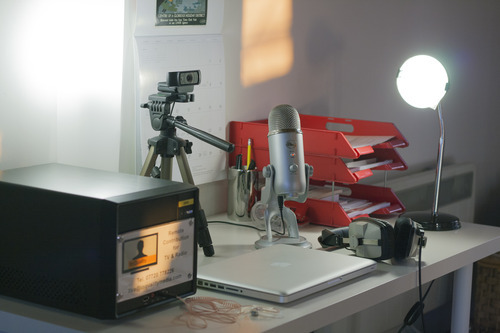
Our Remote Contribution Terminals (above) consist of a small form-factor base unit with prosumer USB webcam and microphone. We’ve had a piece of bespoke software built to control the exposure, focus etc. We use remote access software to manage the equipment remotely so that the interviewee just switches the power on – we do the rest. There’s no need for a local screen, keyboard or mouse which helps reduce clutter, costs and the environmental impact.

WebRTC Digest – Week of 8/26 – Hangouts VP8, WebRTC Camp, Mozilla TinCan

Hangouts Moves to VP8

Google is converting their Hangouts plugin to use VP8 instead of H.264 as a first step in eventually moving Hangouts to use WebRTC. This is significant because it shows their commitment to VP8 and means that we can expect them to continue to push device manufacturers to include the free VP8 hardware encode/decode RTL for high-performance, low-power on mobile.

WebRTC Camp

If you’re interested in learning more about WebRTC, check out the WebRTC Camp taking place on October 20 in Portland, Oregon. The event will be held the day after the Realtime Conference, so you can attend both.

Mozilla TinCan

Mozilla is building a WebRTC demo that uses Persona for authentication called TinCan. The code is on GitHub and you can watch a video demo here: https://mozilla.hosted.panopto.com/Panopto/Pages/Home.aspx.

WebRTC Digest – Week of 7/29 – IETF Berlin and VP8 Patent

IETF Berlin

The RTCWeb participants met at IETF 87 in Berlin. One of the big decisions was that WebRTC “MUST NOT use SDES” for key exchange. As described in this blog postSDES is not very secure since:

SDES uses the signaling channel to send the media encryption keys from one end of the connection to the other. This would necessarily allow the web site to access the encryption keys.

VP8 Patent

Several months ago Nokia filed a lawsuit in Germany against HTC over its VP8-compatible Android devices. Google assisted in the defense of HTC and now the German court has ruled that VP8 does not infringe on a patent owned by Nokia.

WebRTC Digest – Week of 7/22 – Chromecast, WebRTC Book 2nd ed., WebRTC Hacks

Chromecast

Google launched the Chromecast, an HDMI dongle that lets you display tabs from Chrome on your laptop or mobile device on a TV. Assuming the performance is good enough, this sounds like a simple and cheap way to put a WebRTC call on a big screen.

WebRTC Book Second Edition

WebRTC: APIs and RTCWEB Protocols of the HTML5 Real-Time Web is a book dedicated entirely to WebRTC and is now available in a second edition that covers ICE, STUN, and TURN. The book is available both digitally and in paperback.

WebRTC Hacks Blog

Chad Hart, Director of Product Marketing at Acme Packet, teamed up with Reid Steidholph and  Victor Pascual Ávila to create the WebRTC Hacks blog. In their words, it is a blog that

puts a developer audience first

and

helps developers move the WebRTC market forward

WebRTC Digest – Week of 7/15 – WebRTC Book and IETF Unified Plan

WebRTC Book

Ilya Grigorik, Developer Advocate at Google, is in the process of writing a book titled High Performance Browser Networking. A preview of the book is available and it has an entire chapter dedicated to WebRTC, complete with examples and diagrams.

IETF – Unified Plan

RTCWeb IETF working group members came to a compromise on a “Unified Plan for SDP Handling”; the authors include representatives from Mozilla, Google and Microsoft.

WebRTC Digest – Week of 7/8 – Chrome 28, Intel, MediaStream Recording

Chrome 28

Chrome 28 was officially released to the stable channel. The WebRTC-related changes are available in this post to the discuss-webrtc mailing list.

Intel WebRTC

Intel launched a service called “Intel Collaboration Service for WebRTC”, which currently consists of a JavaScript and Android API. Tsahi Levent-Levi speculates that this might result in chipset-level WebRTC support on Intel processors.

MediaStream Recording

Progress is being made on the MediaStream Recording implementation. Support for audio recording landed in Firefox Nightly with progress being tracked in this Bugzilla bug. The Chrome (Blink) team published an “Intent to Implement” document for recording on the blink-dev mailing list and is discussing how best to implement it.

WebRTC Digest – Week of 7/1 – VP9, TURN, Reveal.JS

VP9 in Chrome Dev Channel

VP9, the next-generation video codec and successor to VP8, is now enabled by default in the Chrome Dev channel.

IETF Draft for TURN Credentials

A new IETF draft for requesting time-limited TURN credentials for WebRTC apps was uploaded by Justin Uberti, Tech Lead for WebRTC at Google.

Gestures + Reveal.JS

A fun Chrome Experiment combining Reveal.JS, an HTML presentation framework, and webcam-based gestures was circulating on Twitter: herokuapp.com. The source code is available to fork on GitHub.